Since 1926, and since 1947 shared
Milan and Inter,
they do not mix
{{ quote }}
From the satellite
The stadium, the Trotto, the crossroads
To the north the bare oval of the former trotting track, to the south via San Giusto running down to the crossroads. All maps.
The pages
Four teams around the crossroads, the derby, and everything around them
In the neighbourhood
The other two teams, south of the crossroads
Milan and Inter play in the stadium north of the crossroads. To the south, between via Novara and via delle Forze Armate, Alcione and Triestina have their grounds.
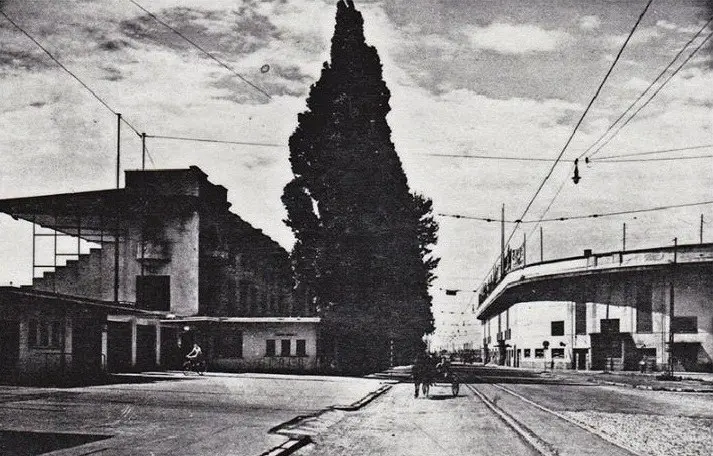
The stadium and the racecourse · 1920s
Stadium and racecourse, 1920s postcard
On the left the 1926 stands, on the right the flat-racing course. Two show machines in open country, north of the line of via Novara. PD-Italy.
Author unidentified · Wikimedia Commons · PD-Italy · original record
Diagram
The stadium seen from the crossroads
The stadium and the street that leads to it: six hundred metres north, from here.
since 1926 Curva Sud Via Novara The crossroads Via San Giusto · 600 m North ↑
Not to scale. The six hundred metres given by Archistadia and YesMilano are between the crossroads and the stadium, not between the crossroads and each of the two ends: for the Curva Nord the distance is greater and is not given here.
-
{{ v.k }}
{{ v.t }}
{{ v.x }}
The two ends
Two ends, the same stadium
The two sides seen from the satellite, and the places around them: via dei Piccolomini, where the venue has its address, and the flat-racing course that has stood beside it since 1920.
{{ cv.club }}
{{ cv.t }}
{{ cv.cr }}
-
{{ px2.d }}
{{ px2.t }}
{{ px2.x }}
The history of the venue is in the chapter San Siro, north of the crossroads; the city grounds and the two ends are in the pages Milan and Inter, and the derby has no places of its own.
Diagram
Three tiers, one above the other
The stadium was not built in one go. Each tier rests on the one before: the first in 1926, the second in 1955 with the ramps outside, the third in 1990 with the towers carrying the roof. The via Piccolomini side, towards the racecourse, stops at the second tier.
- 1926Milan’s stadiumPiero Pirelli has it built; it opens on 19 September with the derby.
- 1935The City’sThe City of Milan buys the venue.
- 1947Inter arriveSince then the two teams have played in the same stadium.
- 1955The second tierThe nineteen spiral ramps outside.
- 1980Giuseppe MeazzaThe stadium takes the player’s name; for the city it remains San Siro.
- 1990The third tierEleven towers and a roof for the World Cup; opening on 25 April.
- 2025The deedOn 5 November the City sells the stadium and its land to the two clubs.
Photographs
The teams, on the pitch
Inter in the 1930s, when the stadium still belongs only to Milan; Milan of the 1961–62 title; Alcione south of the crossroads in 1966; a 1969–70 derby, two teams on the same pitch.
From the collection
The stadium, as it grew
The stadium in nine photographs, from the 1926 building site to the 2022 aerial view: the first tier, the second under construction, the third in 1989. Author, source and licence are under each.
Today
The stadium now, whole and from the crossroads
Two views from above, north at the top: the whole venue, the Curva Nord above and the Curva Sud below; and from the crossroads, the stadium to the north-east with the houses around it. They are satellite images of today (Esri World Imagery), not material of the site.
Archive
The two histories, entry by entry
The documentary archives of the two clubs are published as their sources wrote them, entry by entry, in Italian only. Open the archive, in Italian →
The ground, in six steps
From Milan’s stadium to Milan’s city stadium
The stadium is born private, Milan’s, and passes to the City nine years later. Since 1947 Inter play there too. With the sale of 5 November 2025 it passes to Milan and Inter.
The European finals
Four European Cup finals, none between the two home teams
San Siro has hosted four finals of Europe’s top competition. Only in the first was a Milan team playing: Inter, who won it.
- {{ fi.anno }} {{ fi.data }} {{ fi.partita }} {{ fi.risultato }}
The World Cups
Two World Cups, nine matches
San Siro was a venue of the 1934 and 1990 World Cups. In 1934 it hosted the semi-final won by Italy; in 1990 the opening match and five matches of West Germany, who went on to win the tournament.
{{ mo.anno }}{{ mo.nota }}
- {{ pa.data }} {{ pa.partita }} · {{ pa.fase }} {{ pa.risultato }}
From the photo collection
Stadium and teams in photographs
All records in the photo collection.
Video
The stadium, on video
Videos published on YouTube, with title and channel, in Italian. They load only when you press play.
The national team
Italy return to San Siro
Thursday 12 November 2026 · 20.45
Italy – France
UEFA Nations League, League A, group 1: Italy’s penultimate group match. The Federation chose the Meazza as the last home venue of the group.
1925 – 2021
Ninety-six years
In Milan the national team went unbeaten from January 1925, at the Campo Milan, to October 2021, at San Siro against Spain.
Sources: Calcio e Finanza · Sky Sport · Sportface
Where it continues
- Franco Baresi and Sandro Mazzola, who died in 2026, in In memoriam.
- One hundred years of the stadium, in A hundred years.
- The plan for the new one, in New stadium.
- Birthdays, day by day, in Anniversaries.
- What is scheduled, in Calendar.
Sources for this page
- {{ f.a }} {{ f.t }}
What this page rests on
Every fact is checked against at least two independent sources and, where one exists, the official source.
Two independent sources
Dates, measurements and names go through at least two sources that do not copy each other. Where it exists, we go to the original: the deed, the archive, the body that owns it. What appears in only one place waits.
One version only
If two sources disagree, the original document prevails. If even that is not enough, only the part they agree on is written: the year, for example, instead of the day.
Updated every day
The press review and calendar are updated every day. Everything else changes when a new document turns up, and then it changes everywhere at once.
From the community
Many memories, family photographs and tips come from people who live here, writing to the Facebook page. They are published only if the sender agrees. How to take part: Community.
Everything traceable
Sources are listed above and on the page Sources, with archive, shelfmark and terms of use.
No interpretation passed off as fact
An approximate figure stays approximate, a project stays a project until construction starts, and whatever does not add up stays out. The criteria are in Method.